Cryo Collect

First in France, MéthaTreil valorizes the CO₂ from its biomethane purification

The MéthaTreil Methanization Unit, photo by agriKomp

By  Frédéric DOUARD · 9 juin 2021 ·

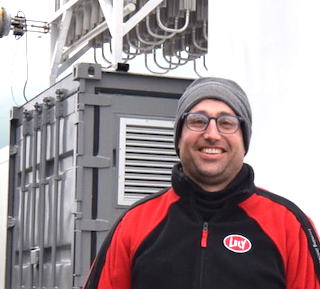
Erwan Bocquier, manager of MéthaTreil,

in front of the CO2 separation module,

photo Frédéric Douard

The MéthaTreil project, carried out in Machecoul-Saint-Même near Nantes, is an agricultural methanization unit for biomethane production. What makes it unique is that it is the first installation in France to recover CO2 from biomethane purification for reuse, instead of releasing it into the atmosphere as all other installations do. This renewable and local CO2, which does not impact the greenhouse effect, avoids the production of CO2 from fossil and imported fuels. This virtuous objective led to the creation of MéthaTreil. It includes three farms that provide the inputs for methanization and two market gardeners, one of whom uses the CO2 for the growth of greenhouse crops. These include Erwan Bocquier and Aymeric Egonneau from Gaec du Treil (livestock farmers and respectively president and general manager of the SAS), Dominique Pilet from Earl Pilet (livestock farmer), Jean-François Vinet from Sas Pom’Retz (market gardener), and Charles Vinet from Sas Retz-Charles (market gardener). The investment amounts to €5 million for biomethane production and €1 million for the CO2 part and will be amortized in 9 to 10 years.

A 100% agriKomp Biomethane plant

The choice of agriKomp was made for two reasons: the project promoters were impressed by the Paddelgigant® paddle stirring system, and they also wanted to deal with a single interlocutor to avoid responsibility disputes between suppliers when problems arise. agriKomp offers support from feasibility studies to the drafting of the ICPE file and subsidy applications, and ensures the sizing, construction, and commissioning of methanization and biomethane purification units, which is rare in the market. Maintenance and biological monitoring are also provided by agriKomp through its dedicated subsidiary ServiceUnion. In terms of timing, less than two years were needed between the contract signing and the first biomethane injection on December 18, 2019.
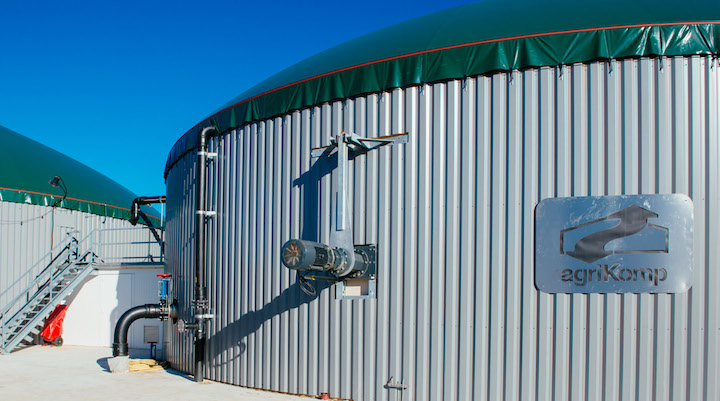
Drive motor of a Paddelgigant agitator at MéthaTreil, photo by agriKomp

The methanization installation includes a Prémix grinder, a Vielfrass® moving floor introduction hopper of 75 m³, two 1,800 m³ digesters, a 4,500 m³ post-digester, and a Quetschprofi® phase separator. Added to these are infrastructures: a 4,200 m³ storage lagoon, 1,880 m² of flat silos for silage and vegetable waste, a 120 m³ slurry and white water pit, a 60 m³ co-product pit, a 500 m² concrete platform for solid digestate, and an old 1,600 m³ slurry pit now used for liquid digestate.
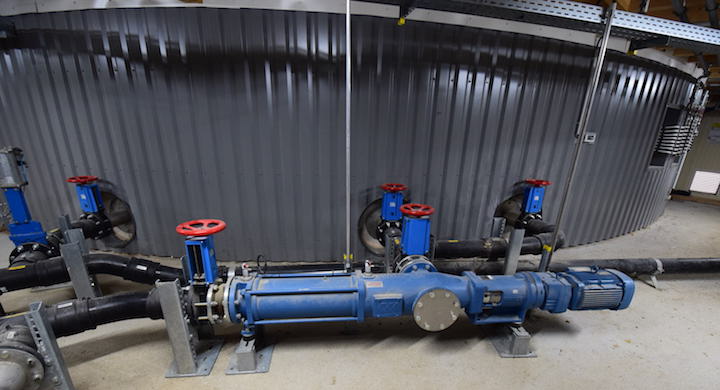
agriKomp uses robust Wangen eccentric screw pumps, photo by Frédéric Douard

The amount of inputs is 13,000 tons per year or 35 tons per day. These include 5,650 tons of bovine manure and slurry, 3,650 tons of silage from cover crops, 1,500 tons of maize silage, 1,100 tons of unmarketable potatoes, and 1,100 tons of vegetable waste (tomatoes, cucumbers, salads, and potatoes, vegetable plants, etc.). The SAS has hired a full-time employee to manage these raw materials.
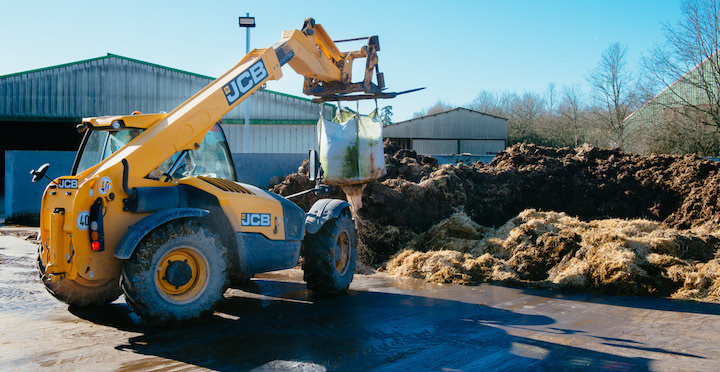
35 tons of inputs are used daily at MéthaTreil, photo by agriKomp

Annually, production exceeds two million m³ of biogas and nearly 12,000 tons of raw digestate. All digestate is processed through the phase separator and spread on the lands of the three associated livestock farmers. This work is carried out by a specialized company working for numerous methanization units in the Pays de Loire region. The company is Efflu’Tec, located in Mortagne-sur-Sèvre in Vendée. It is equipped with practically all existing spreading systems, for both solids and liquids, in trailed, mounted, or cordon form, with simple ramps, injectors, or hoeing, and even with crawler tractors for the least supporting soils.
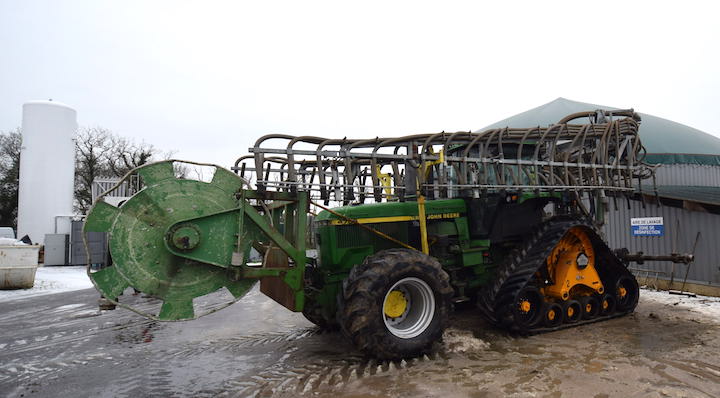
Digestate spreading tractor with drag hose boom from Efflu’Tec, photo by Frédéric Douard

Biomethane purification is performed in an agriPure® module, the membrane filtration solution offered by agriKomp. The gas separation membranes operate on the principle of selective permeation of the membrane surface: the difference in size and solubility of the molecules present in the biogas leads to different permeation rates (penetration into a solid). While carbon dioxide and water pass through the membranes at high speed, methane is retained. This technology allows purification performance exceeding 99% and offers a flexible and scalable solution thanks to the modular system. The module also includes a compression installation, as filtration is carried out under a pressure of 15 bar, and it is then necessary to ensure the desired injection pressure, here 6.5 bar. Part of the heat produced by this compression is recovered and used to heat the digesters in addition to the dedicated boiler.
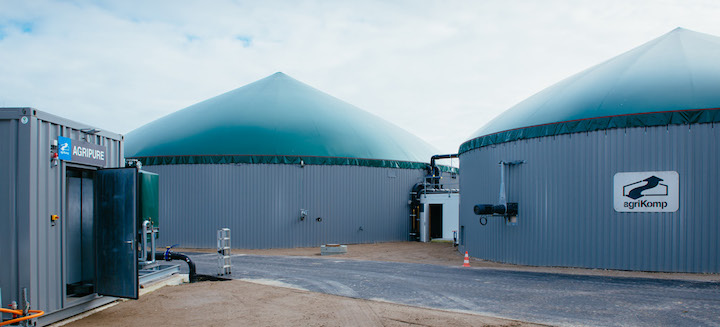
The agriPure biomethane purification module, photo by agriKomp

In Machecoul, the installation’s capacity is 120 Nm³/h. The biomethane is injected into the GRDF network located six kilometers away. This production represents on average nearly 10% of the municipality’s consumption. However, daily network demand fluctuates between domestic and professional consumption (greenhouses). It is necessary to manage storage in gasometers for nightly demand drops (478 m³ per digester and 1,571 m³ in the post-digester) and anticipate production dynamics for weekend demand drops. The longest low-demand period is from August 1 to 15, during which digestion is slowed to avoid flaring.

In terms of working hours for the SAS, excluding maintenance provided by the equipment supplier and outsourced spreading, operating the installation requires 1.5 FTEs.

A Unique BioCO2 Recovery in France

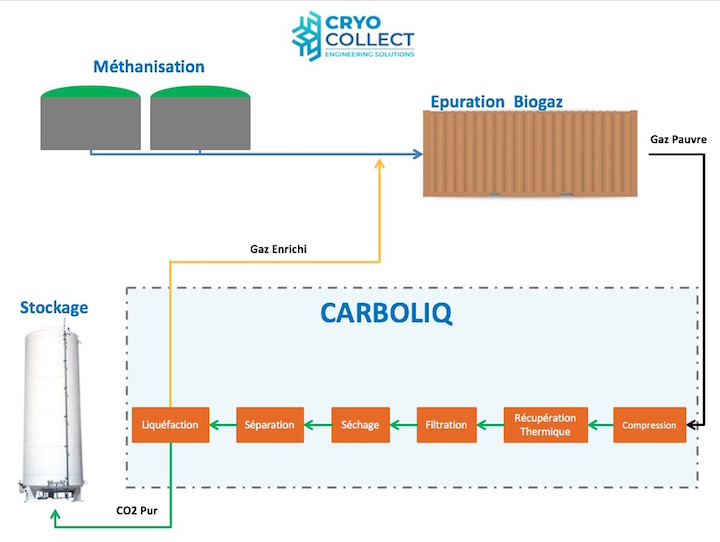
The SAS purifies and liquefies its CO2 through a cold distillation process named Carboliq. To achieve this, it enlisted the help of VerdeMobil, which manufactures and markets this innovative process in France, developed by the startup CryoCollect.
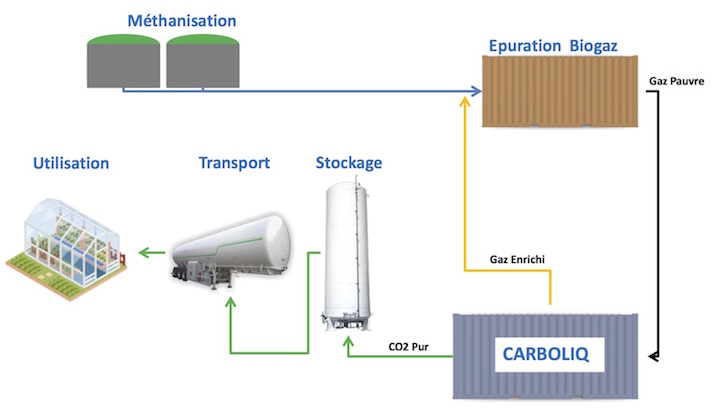
CO2 valorization pathway at Méthatreil, credit CryoCollect

The process recovers low-grade gas from the agriPure® module and isolates the CO2 in liquid form through a series of thermodynamic and physical operations. This chain of operations even allows the recovery of all residual methane from the membrane filtration, which is then recycled into the agriPure® purification module located right next to it.
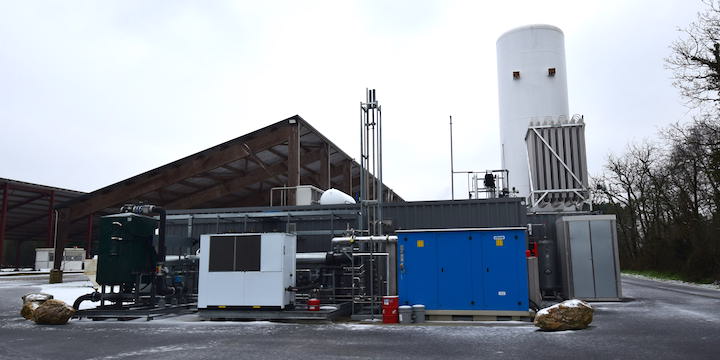
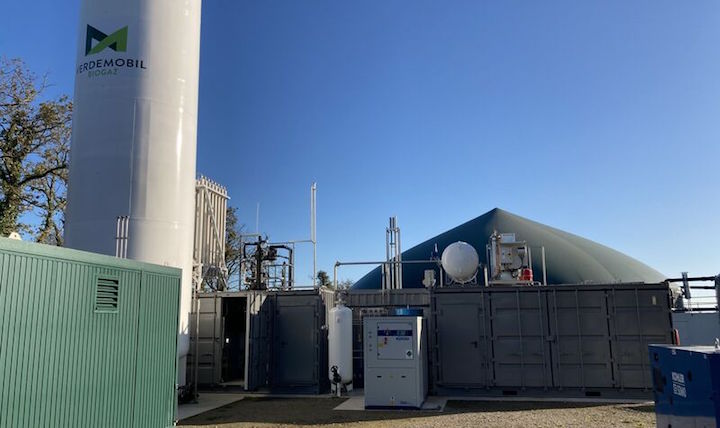
Biomethane and BioCO2 production installation at Méthatreil, with the vertical CO2 storage tank in the background, photo by Frédéric Douard
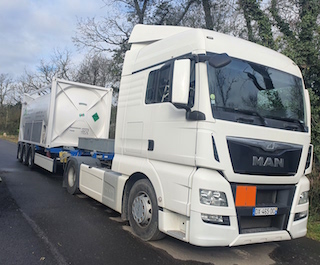
The CO2 shuttle, photo by MéthaTreil

The CO2 is then stored in a 60 m³ vertical tank before being transported once or twice a week by a 20 m³ tanker truck to two 30 m³ relay tanks located at the greenhouse site in Saint-Philbert-de-Grand-Lieu, 15 kilometers from Machecoul, which are partly heated by two wood boilers of 3.9 and 5 MW. The annual CO2 production is 1,500 tons and only meets part of the greenhouse farmer’s needs.

Contacts :

  • MéthaTreil : Erwan Bocquier
 / +33 626 737 530 – sasmethatreil@gmail.com
  • Méthanisation et purification biométhane :
 agriKomp France / +33 254 561 857 
- info@agrikomp.fr – agrikomp.fr
  • Purification et liquéfaction CO2 : CryoCollect 
- Haytham SAYAH / +33 647 56 28 17 – contact@cryocollect.com
 – Verdemobil Biogaz / +33 647 00 21 92 – contact@verdemobil.eu
  • Aquasol, étude ICPE : 
www.bureau-etudes-environnement-35.fr
  • Maintenance processus et biométhane : ServiceUnion France / +33 245 940 016 – service@serviceunion.fr – serviceunion.fr

Frédéric Douard, reporting from Machecoul

Also read on the same topic: CryoCollect extrait un bioCO2 de qualité alimentaire des unités d’épuration de biométhane

Méthabraye, the first French agricultural methanization unit with transported biogas

The Methabraye production site in Savigny with its digester and biofilter, photo by Naskeo

Since April 13, 2018, the methanization unit of SAS Méthabraye located in Savigny-sur-Braye in the Loir-et-Cher has been producing biomethane. In the absence of injection capacity into the natural gas distribution network in the municipality of Savigny-sur-Braye, the project to transport the biomethane was developed. The solution chosen by the Astrade engineering firm is to transport the gas in its liquid form from the biomethane production site to the injection site on the natural gas distribution network.

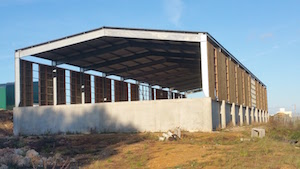
The solid digestate storage building, photo by Méthabraye

A pioneering site

MéthaBraye represents the culmination of six years of work and the development of an innovative solution. It is also the first injection site in the Loir-et-Cher department and the first site in France to use a gas transport solution. It consists of two sites:

  1. The first site, located in Savigny-sur-Braye, at the center of the 17 farms, is the biogas production site, digestate storage site, biomethane purification site, liquefaction site, and the filling station for the cryogenic shuttle that transports the biomethane to Naveil twice a week. The purification and liquefaction process was provided by Verdemobil in partnership with CryoCollect.
  2. The second site is in Naveil, 15 km from Savigny. It is the injection point into the natural gas distribution network.

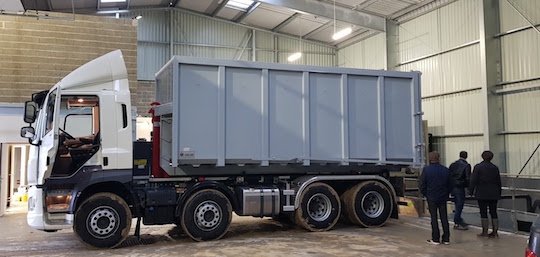
The solid input collection truck, photo by Méthabraye

The organic matter deposit is estimated at 30,000 tons/year, including 86% livestock effluents (manure, slurry) and 14% plant resources (plant waste, CIVE silage). Méthabraye will produce 12 GWh/year of green gas, equivalent to heating 1,000 homes or 47 natural gas vehicle buses.

The project of 17 farms

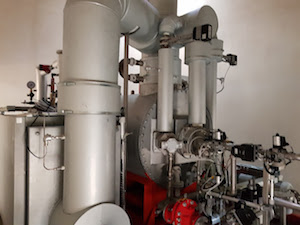
The low-grade gas boiler, photo by Méthabraye

In Savigny-sur-Braye, a commune in the Centre-Val de Loire region, 34 farmers from 17 different farms joined forces to create the company SAS Méthabraye. Their idea: to collectively undertake a methanization project with the valorization of biogas into biomethane and injection into the distribution network. A first in France, as the injection capacity on the network in Savigny-sur-Braye was insufficient, Méthabraye chose to liquefy the biomethane and transport it to an injection point.

Delphine DESCAMPS, president of SAS Méthabraye, explains, “There is indeed a gas network in Savigny, but it did not correspond to our production. Our goal was to match continuous production with discontinuous consumption. It took a lot of time, energy, reflection, responsibility, decisions… Hence the interest of doing this as a group. It also took money. Including studies and land acquisition, the investment is 6.8 million euros. Benefiting from a 20% subsidy from Ademe, the associated farmers contributed their own funds and secured a loan of 5.5 million euros.”

Also, see the video produced by Watts New

Frédéric Douard

10% Increase in Yield at Serres des Trois Moulins with Méthatreil’s BioCO₂

Jean-François Vinet, co-manager and operator of Serres des Trois Moulins, image by VerdeMobil Biogaz

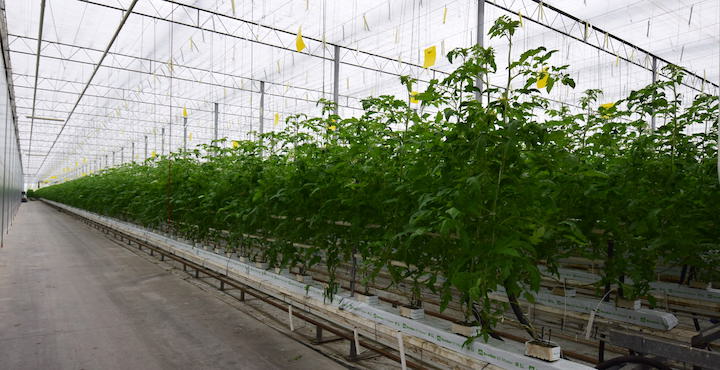
The collaboration between the Méthatreil biomethane plant, located in Machecoul, and the Serres des Trois Moulins greenhouses, located in Saint-Philbert-de-Grand-Lieu in the Loire Atlantique department, dates back to 2020. Méthatreil was then the first installation to valorize bioCO2 in France by supplying the Serres des Trois Moulins. The Brosse Tenaud site spans 13 hectares of greenhouses for cucumbers and tomatoes, and 250 hectares outdoors for lamb’s lettuce, lilies of the valley, and salads. Jean-François Vinet, co-manager and operator, explains in this video that CO2 is essential for greenhouse crop productivity and that it allows for a 10% increase.

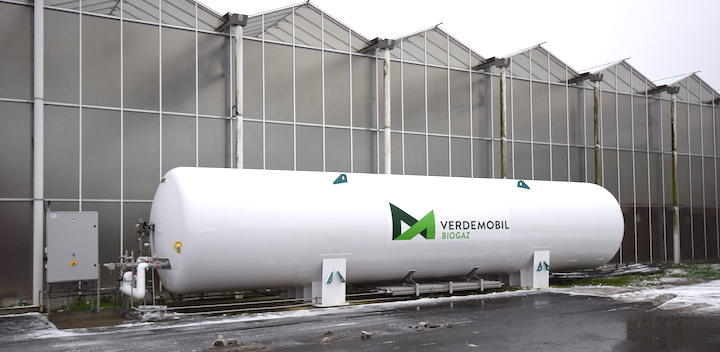
The first bioCO2 tank at Serres des Trois Moulins, photo by Frédéric Douard

Méthatreil purifies and liquefies its CO2 through a cold distillation process called Carboliq. To achieve this, it enlisted the help of VerdeMobil Biogaz, which manufactures and markets this innovative process in France, developed by the startup CryoCollect. The process recovers the low-grade gas from the biomethane purification module and, through a series of thermodynamic and physical operations, isolates the CO2 in liquid form.

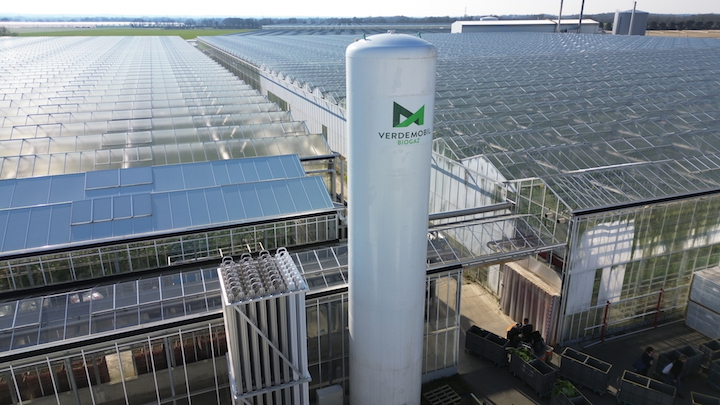
The second BioCO2 tank at Serres des Trois Moulins, photo by VerdeMobil Biogaz

The CO2 is then stored at the methanation site in two vertical tanks of 60 m³, before being transported once or twice a week by a 20 m³ tanker truck to two 30 m³ relay tanks positioned at the greenhouse site, 15 kilometers from Machecoul. The annual production of CO2 is 1,500 tons, which only meets part of the site’s needs.

Contacts :

  • Serres des Trois Moulins : www.3moulins.fr
  • MéthaTreil : Erwan Bocquier
 / +33 626 737 530 – sasmethatreil@gmail.com
  • Purification et liquéfaction CO2 : CryoCollect 
- Haytham Sayah / +33 647 56 28 17 – contact@cryocollect.com
 – VerdeMobil Biogaz / +33 647 00 21 92 – contact@verdemobil.eu – www.verdemobil-biogaz.fr

Frédéric Douard

Also read on the same topic: 

CryoCollect Extracts Food-Grade BioCO₂ from Biomethane Purification Units

Tank of bioCO2 produced by the Carboliq process for a greenhouse farmer in Saint-Philbert-de-Grand-Lieu, photo by Frédéric Douard

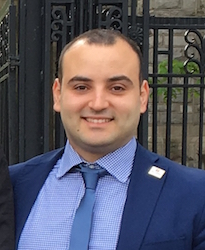
Haytham Sayah, photo CryoCollect

CryoCollect is a startup founded in 2017 by Haytham Sayah and Philippe Khairallah. The company now has six employees, including three engineers and doctors in energy and processes from the École des Mines de Paris. The company’s mission is to develop innovative solutions in the energy sector (purification, liquefaction, etc.) to reduce environmental impacts and to carry out process engineering on innovative projects.

Two industrial firsts achieved in France

In the field of biogas, CryoCollect has already implemented two processes under industrial conditions:

  • A liquefaction process for the biomethane project led by MéthaBraye in the Loir-et-Cher department. This process reduces the volume of the gas by 600 times. Biomethane produced far from the network can thus be transported in tanks to consumer sites or to the network itself.
  • A purification and liquefaction process for the low-grade gas resulting from biomethane purification at Méthatreil in the Loire Atlantique department, to produce food-grade liquid CO2 (EIGA standard).

CO2 recovery and purification installation at MéthaTreil in Machecoul, photo by VerdeMobil

A third micro-liquefaction process for natural gas for vehicles is also under development.

The first BioCO2 unit in France

The development of this purification process took five years of research and benefited from the expertise of the CES (Centre for Energy Efficiency of Systems) at the École des Mines de Paris in thermodynamics and process engineering.

The principle is to recover CO2 from biogas purification and, instead of releasing it into the atmosphere, purify it to valorize it as renewable CO2, substituting fossil CO2 used in numerous industrial applications.

The bioCO2 produced by MéthaTreil is used in greenhouses in Saint-Philbert-de-Grand-Lieu, photo by Frédéric Douard

For the industrialization of the solution, CryoCollect relied on Verdemobil Biogaz, which today constructs the equipment and markets it in the French market.

The Carboliq process

To produce food-grade CO2, it must be extracted from the low-grade gas coming out of biomethane purifiers, knowing that impurity tolerance levels are extremely low. To achieve this, the Carboliq process combines a series of operations that separate the undesirable components from the CO2 one by one.

In the first phase, the low-grade gas is compressed to 20 bar. From there, it is dehydrated by absorption filters. The extraction of volatile organic compounds proceeds in two steps: low-temperature condensation followed by washing.

The Carboliq process

In the second phase, the gas is liquefied by significantly lowering the temperature, causing the downward flow of carbon dioxide, the heaviest element. At the top of the process, in a gaseous sky, residual methane and nitrogen are recovered and sent back to the biomethane purification chain. Thus, CH4 loss is zero, knowing that there can be 0.7 to 3% methane remaining in the low-grade gas. At the bottom of the process, the quality of the CO2 is continuously measured, and when the values are correct, it is extracted in liquid form and stored in a tank.

Contacts : contact@cryocollect.com – contact@verdemobil.com
 – www.verdemobil-biogaz.fr

Frédéric Douard